




Quick Answer
Setting up a steel rolling mill plant typically takes 8 to 24 months, depending on the plant’s production capacity, machinery requirements, site conditions, construction work, and project complexity. A small or medium-sized rolling mill with standard equipment and a ready site may become operational sooner, while a large industrial facility may require two years or more. Proper planning, timely machinery procurement, professional engineering, and efficient installation can help reduce project delays.
Establishing a steel rolling mill plant is a major industrial investment that requires careful planning and technical knowledge. From selecting the right location to installing machinery and testing production systems, every stage plays an important role in completing the project successfully.
Understanding the complete setup process helps manufacturers estimate project costs, prepare resources, and plan their production schedules. If you want to see how the production flow works before planning your project, read our rolling mill process guide.
What Is a Steel Rolling Mill Plant?
A steel rolling mill plant is an industrial facility where heated or cold steel materials are passed through rollers to achieve the required thickness, shape, and dimensions.
The rolling process converts steel billets, blooms, or slabs into finished or semi-finished products such as:
- TMT bars
- Steel rods
- Flat bars
- Angles and channels
- Structural steel sections
- Wire rods
- Steel strips and plates
The machinery and production process depend on the type of steel products a manufacturer wants to produce. Therefore, selecting the right plant configuration is an important first step.
How Much Time Does Each Stage of Steel Rolling Mill Plant Setup Take?
The total project timeline depends on several activities. Some stages can happen simultaneously, while others must be completed in a specific order.
Here is an estimated timeline for a typical greenfield steel rolling mill project.
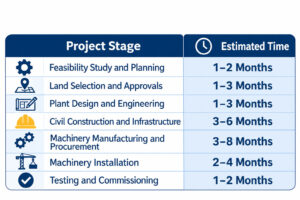
Note: These are indicative planning estimates, not fixed durations. Several activities can overlap, so the total project duration is not simply the sum of every stage.
Let’s understand each stage in detail.
1. Feasibility Study and Project Planning
Estimated time: 1–2 months
The first step is to evaluate whether the proposed steel rolling mill project is technically and commercially practical.
Manufacturers need to identify their target market, expected production capacity, raw material requirements, investment budget, and product range.
Important planning activities include:
- Selecting the type of rolling mill.
- Estimating daily and annual production capacity.
- Identifying raw material suppliers.
- Studying market demand and competition.
- Estimating machinery and operational costs.
- Preparing a preliminary project report.
For example, a manufacturer planning to produce TMT bars will require a different production line configuration compared with a facility producing structural steel sections. Our TMT bar plant setup guide covers the machinery list, layout, and costs for this type of plant.
Proper planning at this stage helps avoid expensive changes during construction and installation.
2. Land Selection and Regulatory Approvals
Estimated time: 1–3 months or longer
The next step is selecting a suitable location for the steel rolling mill plant. The site should have sufficient space for machinery, raw material storage, finished goods, transportation, and future expansion.
Before construction begins, manufacturers should also check applicable regulatory requirements.
These may include:
- Industrial land-use permissions.
- Factory registration and applicable licences.
- Environmental clearances and pollution control approvals.
- Electricity and water supply permissions.
- Fire and workplace safety requirements.
- Local construction and building approvals.
Approval timelines vary depending on the location, plant capacity, and applicable regulations. Starting the approval process early can help prevent unnecessary project delays.
3. Plant Design and Engineering
Estimated time: 1–3 months
Plant design is one of the most important stages because it determines how machinery, production areas, and material handling systems will work together.
An experienced steel rolling mill consultant can help prepare a practical plant layout based on the required production capacity and product specifications.
The engineering process generally includes:
- Production line layout planning.
- Machinery selection and specifications.
- Furnace and heating system design.
- Rolling mill stand arrangements.
- Electrical and automation planning.
- Cooling bed and finishing section design.
- Material handling and storage arrangements.
The design should allow smooth material movement between different production stages. It should also consider equipment maintenance, worker safety, energy consumption, and future production requirements.
4. Civil Construction and Infrastructure Development
Estimated time: 3–6 months
Once the engineering plans are ready and necessary approvals are obtained, civil construction can begin.
The construction requirements depend on the size and configuration of the plant.
Major infrastructure activities include:
- Land preparation and foundation work.
- Construction of machinery foundations.
- Industrial shed and production building development.
- Electrical rooms and utility areas.
- Raw material and finished product storage spaces.
- Internal roads and material transportation areas.
- Water supply and drainage systems.
Machinery foundations require particular attention because heavy rolling mill equipment generates significant loads and vibration during operation.
Accurate foundation work helps ensure proper machinery alignment and stable production performance.
5. Machinery Manufacturing and Procurement
Estimated time: 3–8 months
Machinery procurement is another major factor affecting the overall project timeline. The delivery period depends on equipment specifications, manufacturing capacity, supplier availability, and customization requirements.
A steel rolling mill plant may require several types of machinery and supporting equipment, including:
- Reheating furnaces.
- Rolling mill stands.
- Gearboxes and motors.
- Hydraulic pusher machines.
- Pinch rolls.
- Shearing machines.
- Cooling beds.
- Straightening machines.
- Electrical and automation systems.
Manufacturers should select machinery according to their production requirements rather than focusing only on the initial purchase price.
Working with an experienced steel rolling mill machinery manufacturer can help ensure equipment compatibility and reduce procurement-related problems. Our guide on how to choose the right manufacturer for a hot steel rolling mill plant explains what to look for.
Where possible, machinery manufacturing should begin while civil construction is in progress. This parallel approach can help save valuable project time.
6. Machinery Installation and Assembly
Estimated time: 2–4 months
After the machinery reaches the site and the required foundations and infrastructure are ready, installation work begins.
This stage involves positioning, assembling, aligning, and connecting different machines. RMT Tools also offers dedicated rolling mill installation services for this stage.
Key installation activities include:
- Positioning machinery according to the approved plant layout.
- Installing rolling mill stands and gearboxes.
- Connecting motors and electrical systems.
- Installing hydraulic and lubrication systems.
- Setting up furnaces and material handling equipment.
- Connecting automation and control systems.
- Checking machine alignment and mechanical clearances.
Proper installation is essential for smooth production. Incorrect alignment or poor equipment connections can lead to operational problems, material wastage, and unexpected maintenance requirements.
Experienced technical teams should supervise installation and conduct the required safety checks.
7. Testing and Commissioning
Estimated time: 1–2 months
Once installation is complete, the next step is testing and commissioning the entire production line.
This process checks whether all machinery and supporting systems are functioning correctly.
Commissioning activities generally include:
- Electrical and mechanical testing.
- Motor and gearbox performance checks.
- Furnace temperature testing.
- Hydraulic system inspection.
- Automation and control system testing.
- Trial production using raw materials.
- Product dimension and quality inspection.
During trial production, engineers identify issues related to machine settings, production speed, temperature control, and product quality.
Any necessary adjustments should be completed before commercial production begins.
What Factors Affect the Steel Rolling Mill Plant Setup Time?
Not every steel rolling mill project follows the same schedule. Several factors can increase or reduce the time required to establish a plant.
1. Plant Production Capacity
A small production facility generally requires fewer machines and simpler infrastructure than a large industrial rolling mill. Higher production capacity may require additional equipment, larger foundations, and more complex automation systems.
2. Type of Rolling Mill
Different rolling mill configurations have different engineering and installation requirements. If you are comparing layouts, see the key differences between tandem and cluster steel rolling mills.
For example, a TMT bar rolling mill, structural steel rolling mill, and wire rod mill may require different machinery arrangements and production systems.
3. Machinery Availability
Standard machinery may be available sooner than customized equipment. Delays in manufacturing, transportation, or equipment delivery can affect the entire project schedule.
4. Site Readiness
A site with completed foundations, industrial infrastructure, and available utilities can help speed up installation. However, undeveloped land may require additional preparation and construction time.
5. Project Planning and Technical Support
Poor coordination between designers, machinery suppliers, construction contractors, and installation teams can create unnecessary delays.
Professional engineering support and clear project scheduling help keep different activities on track. A turnkey project approach, where one supplier manages design, supply, and installation, can also reduce coordination problems.
How Can You Reduce the Time Required to Set Up a Steel Rolling Mill Plant?
Manufacturers can improve project efficiency by following a structured approach from the beginning.
Here are some practical ways to reduce setup time:
- Prepare a detailed project plan: Define the production capacity, machinery requirements, budget, and completion targets before starting construction.
- Choose compatible machinery: Select equipment that works together as part of a complete production line.
- Start procurement early: Place machinery orders according to the project schedule to reduce delivery delays.
- Complete approvals on time: Identify regulatory requirements before beginning major construction activities.
- Coordinate different teams: Maintain communication between engineering, construction, machinery suppliers, and installation professionals.
- Plan installation in advance: Prepare foundations, electrical connections, and utility systems before equipment arrives.
- Conduct proper testing: Identify and resolve technical issues during commissioning instead of waiting until commercial production.
These steps can help improve project coordination, control costs, and avoid unnecessary downtime during the setup process.
Why Is Professional Steel Rolling Mill Consultancy Important?
Setting up a rolling mill requires more than purchasing industrial machinery. Manufacturers need to understand production requirements, equipment selection, plant layout, engineering specifications, and installation procedures.
An experienced steel rolling mill consultant can support manufacturers at different stages of the project. RMT Tools provides end-to-end support for setting up new plants, and also helps with revamping old plants.
Professional consultancy may help with:
- Plant layout and production planning.
- Machinery selection and technical specifications.
- Rolling mill process optimization.
- Equipment configuration and installation guidance.
- Production capacity planning.
- Technical troubleshooting and operational improvements.
The right technical guidance can help manufacturers make informed investment decisions and build a production facility that meets their long-term requirements.
Conclusion
Setting up a steel rolling mill plant typically takes around 8 to 24 months, although the actual timeline depends on production capacity, machinery requirements, site readiness, approvals, and project complexity.
Every stage, from feasibility planning and plant engineering to machinery installation and commissioning, requires proper coordination. Investing time in selecting the right equipment and planning the production process can help reduce delays and improve long-term operational efficiency.
Planning to establish a new steel rolling mill plant? Contact RMT Tools for professional guidance on rolling mill machinery, plant setup, and engineering solutions.
Frequently Asked Questions (FAQs)
How many months are required to set up a steel rolling mill plant?
A steel rolling mill plant may take approximately 8 to 24 months to establish. The timeline depends on plant capacity, site conditions, machinery availability, construction, and commissioning requirements.
What is the first step in setting up a steel rolling mill?
The first step is conducting a feasibility study and preparing a project plan. Manufacturers should determine production capacity, product requirements, investment estimates, raw material availability, and machinery specifications.
Which machinery is required for a steel rolling mill plant?
Common equipment includes reheating furnaces, rolling mill stands, gearboxes, motors, shearing machines, pinch rolls, cooling beds, straightening machines, and electrical automation systems. The exact machinery depends on the products being manufactured. You can browse the full range on our rolling mill machinery page.
How long does it take to install rolling mill machinery?
Machinery installation generally takes around 2 to 4 months for a typical project. However, the duration depends on equipment quantity, plant size, installation complexity, and site readiness.
Can a steel rolling mill plant be set up in less than one year?
Yes, some small or medium-sized projects may become operational within 8 to 12 months if the site is ready, approvals are completed, standard machinery is available, and construction and procurement activities are properly coordinated.
What are the major factors affecting rolling mill plant setup costs and time?
The main factors include production capacity, machinery specifications, land and construction requirements, electrical infrastructure, equipment availability, regulatory approvals, and installation complexity.
Why should manufacturers hire a steel rolling mill consultant?
A professional consultant can help with plant planning, machinery selection, production line design, technical specifications, and installation guidance. This support can help manufacturers avoid planning mistakes and improve project execution.
When can a newly installed steel rolling mill start commercial production?
Commercial production can begin after machinery installation, testing, trial runs, quality checks, and necessary operational approvals are completed. The commissioning team should confirm that the production line is safe and operating as expected.