




Quick Answer
The cost of a rebar rolling mill plant in India depends on several factors, including production capacity, rebar size range, mill configuration, automation, reheating furnace capacity, TMT requirements, and the equipment included in the project. There is no single price that applies to every plant.
As a rough guide, a complete rebar rolling mill project in India can range from approximately US1milliontoUS15 million or more (about ₹10 crore to ₹150 crore+), depending on capacity, automation, and project scope. A small mill sits at the lower end, and a high-capacity continuous mill at the upper end.
A complete project cost can also include civil work, electrical infrastructure, installation, commissioning, material handling, and other site requirements. For this reason, buyers should compare quotations based on the complete equipment scope rather than looking only at the machinery price.
Introduction
Setting up a rebar rolling mill plant is a significant investment for steel manufacturers and entrepreneurs. The required investment can vary considerably depending on the production target, product specifications, plant configuration, and level of automation.
If you are planning a new plant or expanding an existing steel facility, understanding the major cost factors can help you prepare a realistic project budget and request more accurate quotations from manufacturers. If you are new to the process, our guide to the rolling mill process explains how billets become finished bars.
How Much Does a Rebar Rolling Mill Plant Cost in India?
There is no fixed price for a rebar rolling mill plant because every project is designed around different production and technical requirements. However, the table below gives a practical idea of the approximate investment range for each plant type.
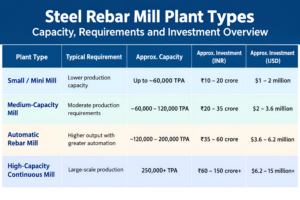
Figures are indicative estimates for a complete rolling mill project (equipment, installation, and basic civil and electrical work) for a plant that buys billets. They exclude GST, land, and a steel melting shop. USD values are converted at approximately ₹96 = US$1 and will change with exchange rates.
These categories are only indicative. The actual investment depends on the machinery specification, furnace capacity, automation, product range, and additional equipment required. An integrated plant that also includes its own melting shop and continuous caster will cost considerably more than the figures above.
For an accurate project estimate, buyers should provide their production target, billet dimensions, finished bar sizes, and other technical requirements to the manufacturer. You can contact our team to discuss your requirements.
What Determines the Cost of a Rebar Rolling Mill Plant?
Several factors influence the final cost of a rebar rolling mill project.
Production Capacity
Production capacity is one of the most important cost factors. A plant designed to produce a higher number of tonnes per hour generally requires larger and more powerful equipment.
Capacity also affects the size of the reheating furnace, rolling stands, motors, gearboxes, cooling systems, material handling equipment, and automation.
For example, a plant designed for a small production target will have different equipment requirements from a high-output continuous rolling mill. For a deeper look at this, read why high-capacity hot rolling machine design matters for performance.
Rebar Size and Product Range
The range of rebar sizes you plan to manufacture also affects the mill configuration.
Producing different sizes may require suitable roll-pass designs, rolling stands, guides, and finishing arrangements. A plant producing a wider range of bar sizes may therefore require a more flexible configuration.
Before selecting machinery, buyers should clearly define the required finished sizes, such as 8 mm, 10 mm, 12 mm, 16 mm, 20 mm, 25 mm, or 32 mm.
Rolling Mill Configuration
The number and arrangement of rolling stands influence both the technical design and investment.
A rebar rolling mill may include roughing, intermediate, and finishing stands. Horizontal and vertical arrangements can also be selected according to the required production process and plant design. Our rolling mill stands and housing-less stands are designed for different mill layouts. You can also compare tandem and cluster steel rolling mills to see which fits your plan.
The right configuration depends on production capacity, billet size, finished product range, rolling speed, and quality requirements.
Automation Level
Automation can influence the initial investment, but it can also improve process control, production consistency, and operational efficiency.
A basic setup may require more manual operation, while a highly automated plant can include automated controls, DC/AC drives, monitoring systems, and material handling.
The appropriate automation level should be selected according to production volume, labour availability, quality requirements, and the overall project budget.
Reheating Furnace
The reheating furnace is another major component of a rebar rolling mill plant.
Its cost depends on factors such as:
- Furnace capacity
- Billet dimensions
- Heating requirements
- Fuel system
- Temperature control
- Furnace design
A higher-capacity rolling line generally requires a furnace capable of supplying billets at the required rate. To learn more, see reheating furnace working principles and design and the key challenges in operating reheating furnaces.
TMT Quenching System
If the plant is designed to produce TMT bars, a controlled quenching system becomes an important part of the production line.
The TMT plant system controls the cooling process after rolling to help achieve the required mechanical properties. Therefore, TMT production may require additional equipment compared with a conventional rebar rolling setup, which adds to the overall investment.
Finishing and Handling Equipment
The final project configuration may also include cooling beds, shearing machines, roller tables, bundling systems, and other material-handling equipment such as EOT cranes.
The quantity and capacity of these systems depend on the production rate and finished-product requirements.
Rebar Rolling Mill Plant Cost Breakdown
Instead of considering the rolling mill as a single machine, buyers should evaluate the complete equipment package.
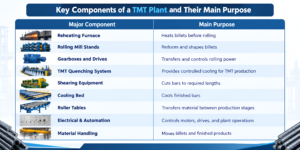
The final quotation depends on the exact specifications, capacity, configuration, and equipment scope selected for the project.
Machinery Cost vs. Total Project Cost
One of the most important points for new buyers is that machinery cost is not always the same as total plant investment. The approximate figures in this guide refer to the overall rolling mill project. A machinery-only quotation will naturally be lower, because it leaves out items such as civil work, building, and utilities.
What Machinery Cost Usually Covers
A machinery quotation may cover selected equipment such as rolling mill stands, gearboxes, motors, furnace systems, shearing equipment, cooling beds, electrical systems, or automation.
However, the exact scope differs from one manufacturer and project to another.
Always check what is included and excluded before comparing quotations.
Additional Project Costs
Depending on the project, buyers may also need to budget for:
- Civil foundations
- Factory building or shed
- Electrical infrastructure
- Transformer and power connection
- Water systems
- Installation
- Commissioning
- Material handling
- Utilities
- Site development
- GST and other applicable taxes
These expenses can have a significant effect on the overall project investment. If you prefer a single point of responsibility for design, supply, and setup, consider our turnkey projects and new plant setup services.
How Does Production Capacity Affect Rebar Rolling Mill Cost?
Capacity should be decided before selecting the machinery configuration.
Small-Capacity Rebar Rolling Mill
A smaller plant may be suitable for businesses with lower production requirements. Its equipment and utility requirements are generally lower than those of a large-scale automated mill.
Approximate investment: ₹10 – 20 crore (about US$1 – 2 million).
Medium-Capacity Rebar Rolling Mill
A medium-capacity plant requires a more substantial production setup, including suitable furnace capacity, rolling equipment, drives, cooling systems, and material handling.
Automation requirements may also increase depending on the desired production rate and operating model.
Approximate investment: ₹20 – 35 crore (about US$2 – 3.6 million).
High-Capacity Rebar Rolling Mill
Large-scale plants require equipment capable of handling higher production speeds and material volumes.
These projects may involve larger drives, higher-capacity furnaces, advanced automation, faster rolling systems, and more extensive material handling infrastructure.
Approximate investment: ₹60 – 150 crore or more (about US$6.2 – 15 million+). Mid-to-large automatic mills fall between the medium and high-capacity ranges, at roughly ₹35 – 60 crore (US$3.6 – 6.2 million).
What Equipment Is Required for a Rebar Rolling Mill Plant?
A typical rebar rolling mill project may include:
- Reheating furnace
- Rolling mill stands
- Gearboxes and motors
- TMT quenching system, where required
- Shearing machines
- Cooling bed
- Roller tables
- Electrical and automation systems
- Material handling equipment, along with auxiliary equipment
The exact equipment list depends on the plant capacity, product range, production process, and level of automation.
For detailed information about individual machines, buyers should review the manufacturer’s specific product and technical pages.
What Additional Costs Should You Budget For?
Apart from machinery, a project budget should account for other requirements.
These may include:
- Land and building
- Civil construction
- Electrical infrastructure
- Installation
- Commissioning
- Utilities
- Labour
- Initial raw-material inventory
- Working capital
Not every project will have the same expenses. The location, existing infrastructure, plant expansion plans, and equipment scope can significantly change the total investment. If you are upgrading an existing facility, our plant revamping services can help you modernize equipment without rebuilding from scratch.
How to Estimate the Cost of Your Rebar Rolling Mill Project
Before requesting a quotation, prepare the basic technical details of your proposed plant.
Consider the following:
- Required production capacity in TPH
- Annual production target
- Billet size
- Finished rebar sizes
- Steel grade
- TMT or conventional rebar production
- Required automation level
- Available power supply
- Required equipment
- Plant location
- New plant or expansion of an existing facility
Example
Suppose a buyer wants to establish a plant for producing multiple rebar sizes with TMT processing. Instead of asking only for the “price of a rebar rolling mill,” the buyer should provide the required capacity, billet dimensions, product range, TMT requirements, and preferred automation level.
With these details, the manufacturer can recommend a suitable configuration and prepare a project-specific quotation. Our designing services team can help with plant layout and configuration at this stage.
How to Choose a Rebar Rolling Mill Manufacturer in India
The lowest machinery quotation is not always the best choice. Buyers should evaluate the manufacturer based on the complete project requirement. For a detailed checklist, read how to choose the right manufacturer for your hot steel rolling mill plant.
Consider:
- Manufacturing experience
- Engineering and design capability
- Equipment quality
- Plant customization
- Automation solutions
- Installation and commissioning support
- Spare parts availability
- Technical assistance
- After-sales service
A manufacturer that understands the complete production process can help buyers select equipment that matches their capacity and product requirements. Product quality also matters, so see how rebar manufacturers in India meet international steel quality standards.
Why Choose RMT Tools for a Rebar Rolling Mill Plant?
RMT Tools provides rolling mill machinery and equipment for steel production applications. Its product range includes rolling mill equipment, rolling mill stands, reheating furnaces, shearing machines, cooling beds, gearboxes, and other systems used in rolling mill projects. You can learn more about the company on our company profile and infrastructure pages.
For buyers planning a new rebar rolling mill or upgrading an existing facility, the equipment configuration should be selected according to the required production capacity, product range, and plant requirements.
Get a Rebar Rolling Mill Plant Quotation
The approximate prices above are a starting point for budgeting. The most reliable way to determine your project cost is to request a quotation based on your actual production requirements.
When contacting a manufacturer, provide details such as:
- Required TPH
- Billet size
- Rebar size range
- TMT or conventional production
- Plant location
- Automation requirements
- Required equipment
RMT Tools can use these project details to help determine a suitable equipment configuration and prepare a project-specific quotation. Contact RMT Tools to request your quotation.
Related Resources
- Rebar Mill: Product Details
- A Complete Guide to Modern Rolling Mill Machine Technology
- Advanced Steel Rolling Mill Plant Solutions in India
- Complete Maintenance Checklist for Rolling Mill Machinery
Frequently Asked Questions
How much does a rebar rolling mill plant cost in India?
There is no single fixed price, but a complete project typically ranges from approximately US1milliontoUS15 million or more (about ₹10 crore to ₹150 crore+). The cost depends on production capacity, rebar sizes, rolling mill configuration, furnace capacity, automation, TMT requirements, and the equipment included in the project.
What factors affect rebar rolling mill plant cost?
The major factors include production capacity, billet size, finished rebar range, mill configuration, automation, reheating furnace capacity, TMT equipment, and material-handling requirements.
How much does a small rebar rolling mill cost?
A small rebar rolling mill project may cost approximately ₹10 – 20 crore (about US$1 – 2 million), depending on its required production capacity and equipment configuration. Buyers should request a project-specific quotation rather than relying on a generic market price.
What equipment is required for a rebar rolling mill plant?
A typical plant may require a reheating furnace, rolling mill stands, gearboxes and motors, shearing equipment, cooling bed, roller tables, electrical and automation systems, and material-handling equipment. A TMT quenching system is required when producing TMT bars.
Does the machinery price include installation and commissioning?
Not necessarily. Installation and commissioning may be included or quoted separately depending on the manufacturer and project scope. Buyers should confirm these details before comparing quotations.
What is the difference between machinery cost and total project cost?
Machinery cost refers to the equipment supplied for the rolling mill. Total project cost can also include civil work, building, electrical infrastructure, utilities, installation, commissioning, taxes, and other site-related expenses.
How much capacity should I choose for a rebar rolling mill?
The right capacity depends on your target production volume, market demand, available raw materials, power supply, product range, and investment plan. Capacity should be finalized before selecting the mill configuration.
How can I get a quotation for a rebar rolling mill plant?
Provide the manufacturer with your required TPH, billet size, finished rebar sizes, TMT or conventional requirement, automation level, location, and equipment scope. These details allow the manufacturer to prepare a more accurate project-specific quotation. Get in touch with RMT Tools to start.