




Brazil has a large steel industry serving construction, infrastructure, automotive, and other sectors. Modern rolling mills help steel producers make finished products faster, reduce waste, control quality, and lower production costs.
Quick Answer
Rolling mills improve steel production by changing billets, blooms, or slabs into finished steel products such as bars, wire rods, plates, and coils. For a steel plant in Brazil, modern rolling equipment can improve production speed, product quality, energy use, and material yield. A turnkey steel mill can also make plant development easier by bringing engineering, equipment, installation, and commissioning under one coordinated project.
Brazil’s Steel Industry
Brazil is one of the important steel-producing countries in Latin America. Its steel industry supplies materials for construction, infrastructure, manufacturing, automotive production, and other industrial applications. Industry-wide data and updates on the sector are published by Instituto Aço Brasil, the trade association representing Brazil’s steel producers, and by the World Steel Association, which tracks global crude steel production and industry trends.
However, steel producers face several challenges, including changing demand, production costs, energy expenses, and competition from imported steel. These factors make production efficiency important for every steel mill in Brazil.
Modern equipment can help producers use resources more effectively while maintaining consistent product quality. For this reason, rolling mill technology has an important role in improving the performance of both new and existing steel plants.
What Does a Rolling Mill Do?
A rolling mill changes semi-finished steel into products that can be used by customers and other industries.
During the rolling process, steel passes through a series of rolls. The rolls reduce the thickness or change the shape of the steel while controlling its size and surface quality.
Depending on the type of mill, the finished product may include:
- Reinforcement bars
- Wire rods
- Round bars
- Flat bars
- Structural sections
- Plates
- Coils
In a steel plant in Brazil, the rolling mill connects important stages of production. Steel produced through melting and casting can be processed into finished products that meet the required dimensions and specifications.
How Modern Rolling Mills Improve Steel Production
1. Higher Production Output
Modern rolling mills are designed to process steel efficiently. Continuous rolling systems allow material to move through several rolling stands with fewer interruptions.
Automation can also help control rolling speed, roll gaps, and other important production settings. This can reduce unnecessary delays and help the plant produce more tonnes during each shift.
For a steel mill in Brazil, higher output can help make better use of existing production capacity.
2. Better Product Quality
Steel products must meet specific size, shape, and quality requirements. Small differences in thickness or dimensions can affect the final product.
Modern rolling equipment uses automatic controls and monitoring systems to maintain more consistent dimensions. Better control can reduce defective products, rework, and material loss.
This is especially useful when supplying customers who require steel products according to specific technical standards.
3. Lower Energy Use
Energy is an important operating cost in steel production. Efficient rolling equipment can help reduce energy consumption for each tonne of finished steel.
Better pass schedules, temperature control, motor systems, and process automation can improve the overall efficiency of the rolling process.
Lower energy consumption can help a steel plant in Brazil control operating costs while supporting more efficient production.
4. Less Material Waste
Material loss can increase production costs. If a product does not meet the required specifications, it may need to be reprocessed or rejected.
Modern rolling mills provide better control over dimensions, temperature, and rolling conditions. This can help reduce off-spec material and improve overall yield.
Better yield means more usable steel from the same amount of input material.
5. Greater Product Flexibility
Steel customers do not always need the same type or size of product. A modern rolling line can be designed to produce different products with suitable roll systems, tooling, and process settings.
This gives a steel mill in Brazil more flexibility to serve different markets, including construction, infrastructure, manufacturing, and industrial applications.
Rolling Mill Technologies for Modern Steel Plants
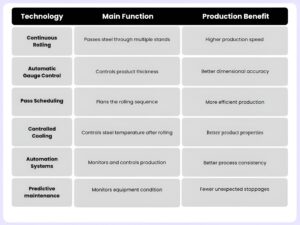
These technologies can be selected according to the product, production capacity, available space, energy requirements, and investment plans of the plant.
Why Consider a Turnkey Steel Mill?
Developing a rolling mill requires more than purchasing machines. A project may also require engineering, plant layout, electrical systems, automation, installation, testing, commissioning, and operator training.
A turnkey steel mill project brings these activities together under one coordinated project. Instead of managing several equipment suppliers separately, the producer can work with one project partner for major stages of development.
Some potential benefits include:
- Simpler project management: One main partner coordinates different project activities.
- Better equipment integration: Machines and control systems can be planned to work together.
- Faster commissioning: Installation, testing, and start-up can be coordinated as part of the project.
- Clearer project scope: Equipment, engineering, and commissioning responsibilities can be defined in advance.
- Operator support: Training can help plant teams understand the equipment and production process.
The exact benefits depend on the project scope, equipment design, site conditions, and contract terms.
Challenges for Steel Plants in Brazil
Steel producers in Brazil need to consider several factors when planning a new mill or upgrading an existing facility.
Import Competition
Imported steel can create pricing pressure for domestic producers. Efficient production can help mills control their cost per tonne and respond to market changes. Instituto Aço Brasil publishes sector statistics and trade data relevant to this issue.
Energy Costs
Rolling and related steelmaking processes require significant energy. Efficient equipment and good process control can help reduce unnecessary energy consumption.
Equipment Maintenance
Unexpected equipment failures can stop production and increase maintenance costs. Preventive and predictive maintenance systems can help identify equipment problems before they result in major downtime.
Changing Customer Requirements
Customers may require different steel sizes, grades, and product types. A flexible rolling line can help producers respond to changing market requirements.
How to Choose Rolling Mill Equipment
Before selecting equipment for a steel plant in Brazil, producers should consider more than the initial machine price.
Important factors include:
- Required production capacity
- Steel product and size range
- Available billet or slab dimensions
- Energy consumption
- Automation requirements
- Plant layout
- Equipment maintenance needs
- Spare parts availability
- Installation and commissioning support
- Supplier experience with similar projects
A detailed technical and commercial evaluation can help determine whether a new rolling line, equipment upgrade, or complete turnkey steel mill project is suitable for the plant.
Conclusion
Rolling mills play an important role in turning semi-finished steel into useful products. Modern rolling technology can help a steel plant in Brazil improve production speed, product quality, material yield, and energy efficiency.
For producers planning a new facility or a major expansion, a turnkey steel mill approach can simplify project coordination by combining engineering, equipment, installation, and commissioning. The right solution will depend on the plant’s products, capacity, site conditions, and long-term production goals.
Planning a new rolling line or upgrading an existing steel mill? Explore RMT Tools’ rolling mill machinery and complete steel plant solutions to find an option suited to your production requirements.
Frequently Asked Questions
What does a rolling mill do?
A rolling mill reduces the thickness or changes the shape of semi-finished steel. It can produce finished products such as rebar, wire rod, bars, plates, coils, and structural sections.
How can a rolling mill increase production?
Modern rolling mills can use continuous processing, automation, optimized rolling sequences, and better process control. These features can reduce production interruptions and improve the amount of steel processed during each shift.
What is a turnkey steel mill?
A turnkey steel mill is a project where one main supplier or contractor manages major stages such as engineering, equipment supply, installation, commissioning, and training. The exact scope depends on the project agreement.
Why is automation important in a steel mill?
Automation helps operators monitor and control important production parameters such as rolling speed, temperature, dimensions, and equipment performance. It can improve consistency and reduce manual errors.
What should a Brazilian steel producer consider before upgrading a rolling mill?
The producer should review production capacity, product requirements, energy consumption, equipment condition, automation needs, maintenance requirements, plant layout, and future production plans before selecting an upgrade.