




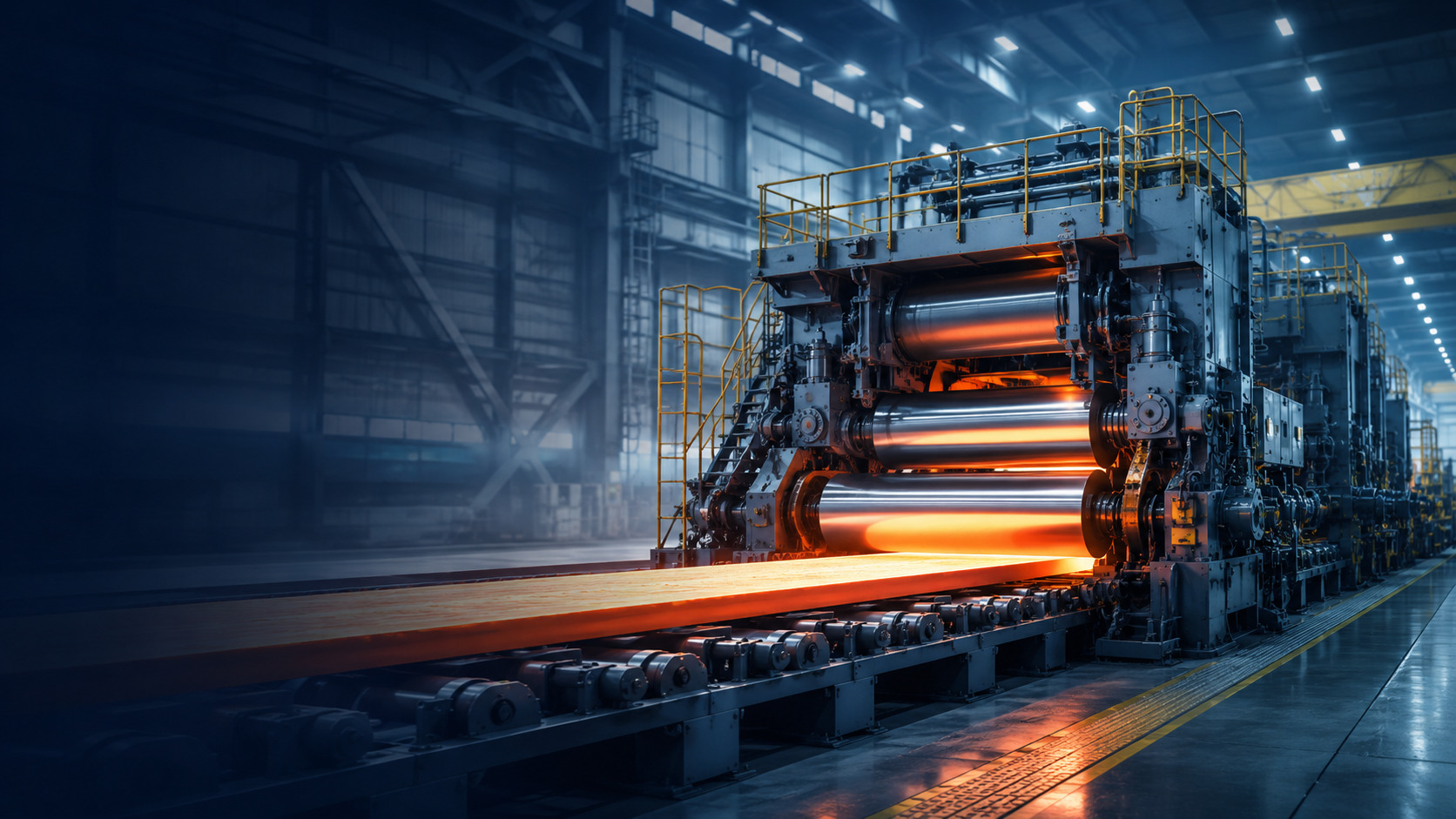
Steel manufacturing is evolving rapidly as producers look for ways to improve productivity, maintain consistent quality, reduce waste, and control operating costs. One of the most important technologies supporting this progress is the rolling mill machine.
Modern rolling mills do much more than reduce the thickness or change the shape of steel. Today’s systems can combine advanced mechanical equipment with automation, sensors, digital monitoring, hydraulic controls, and data-based maintenance. These improvements help manufacturers achieve better process control and more consistent production results.
But how do you choose the right rolling mill machine? Where can you find reliable rolling mill equipment? And what should you compare before investing in a new system or upgrading an existing plant?
This complete guide answers these questions and explains the different types, applications, benefits, technologies, and selection factors that steel manufacturers should understand.
What Is a Rolling Mill Machine?
A rolling mill machine is industrial equipment used to reduce the thickness of steel or change its shape by passing the material between rotating rolls. Controlled pressure is applied as the steel moves through the rolling stands, allowing manufacturers to produce specific dimensions and profiles.
Rolling mills are commonly used to manufacture:
- Steel plates
- Sheets and strips
- Bars and rods
- Structural sections
- Rails
- Wire rods
- Specialized steel profiles
A complete rolling mill may include work rolls, backup rolls, motors, gearboxes, hydraulic systems, cooling equipment, sensors, and automated control systems. The exact configuration depends on the type of steel product, production capacity, and required output specifications.
How Does Modern Rolling Mill Technology Work?
The basic rolling principle is straightforward. Steel passes between rotating rolls, which apply pressure to reduce its thickness or change its shape.
Modern rolling mills, however, use advanced technology to control the process more accurately. Depending on the production line, sensors and automated systems can monitor the following:
- Rolling force
- Steel temperature
- Material thickness
- Roll speed
- Product dimensions
- Line tension
- Cooling conditions
This real-time information allows operators and control systems to make adjustments during production. As a result, manufacturers can improve dimensional accuracy, process stability, and product consistency.
What Are the Main Types of Rolling Mills?
Different rolling mill designs are used for different production requirements.
Two-High Rolling Mill
A two-high rolling mill uses two rolls to process steel. It is a relatively simple configuration and can be used for basic rolling applications.
Three-High Rolling Mill
A three-high rolling mill contains three rolls. This design allows material to pass through the mill in different directions without reversing the rotation of the rolls.
Four-High Rolling Mill
A four-high mill uses smaller work rolls supported by larger backup rolls. The backup rolls help reduce roll deflection and improve thickness control.
Cluster Rolling Mill
Cluster mills use multiple backup rolls to support smaller work rolls. They are suitable for applications requiring high levels of thickness precision.
Continuous Rolling Mill
Continuous rolling mills use multiple stands arranged in sequence. They are designed for efficient, high-volume production where consistent output and productivity are important.
The right configuration depends on the product being manufactured, required production capacity, material size, and dimensional accuracy.
What Is the Difference Between Hot Rolling and Cold Rolling?
One of the most important decisions when selecting rolling technology is whether the production process requires hot rolling or cold rolling.
Hot rolling processes steel at elevated temperatures, making the material easier to deform. It is commonly used for large reductions and products such as plates, structural sections, rails, and bars.
Cold rolling takes place at or near room temperature. It is generally selected when manufacturers require tighter dimensional tolerances, better surface finish, or specific mechanical properties.
The best process depends on the final product requirements and the specifications of the steel being manufactured.
Why Is Modern Rolling Mill Technology Important?
Modern rolling mill technology helps steel manufacturers address several important production challenges.
1. Higher Production Efficiency
Automated systems can reduce manual intervention and help maintain stable production conditions. This can support higher throughput and better utilization of equipment.
2. Better Product Quality
Advanced controls help maintain consistent thickness, width, shape, and other product characteristics. Automated measurement systems can identify variations during production and allow corrective action.
3. Lower Material Waste
Accurate control can reduce dimensional errors, rejected products, and unnecessary material losses. Better process control also helps manufacturers produce steel closer to required specifications.
4. Greater Automation
Modern mills can use sensors and digital control systems to collect production data in real time. Operators can use this information to monitor equipment and adjust process parameters.
5. Better Energy Management
Heating and rolling are energy-intensive processes. Improved temperature control, efficient drives, and optimized production parameters can help manufacturers manage energy consumption more effectively.
Where Can You Find a Rolling Mill Machine?
Manufacturers looking for rolling mill equipment can find potential suppliers through several channels. The best approach is to compare multiple sources rather than selecting equipment based only on price.
1. Rolling Mill Machine Manufacturers
Directly contacting manufacturers is often a good starting point. Manufacturers can provide information about machine specifications, production capacity, customization options, installation, commissioning, and after-sales support.
2. Industrial Machinery Suppliers
Industrial equipment suppliers may offer different types of rolling mill machinery and related components. This can be useful when comparing equipment from different manufacturers.
3. Engineering and Turnkey Project Companies
For a complete steel plant or major expansion, engineering companies and turnkey project providers may offer integrated solutions that include equipment selection, plant design, installation, and commissioning.
4. Industrial Trade Platforms and Directories
Online industrial marketplaces and business directories can help buyers identify potential suppliers. However, buyers should verify technical capabilities, certifications, project experience, and customer references before making a decision.
5. Industry Exhibitions and Trade Events
Steel and metalworking exhibitions provide opportunities to meet machinery manufacturers, technology providers, and engineering companies. These events can be useful for comparing available technologies and discussing specific production requirements.
How Should You Compare Rolling Mill Machine Suppliers?
Finding a supplier is only the first step. The next step is comparing suppliers based on factors that affect long-term performance.
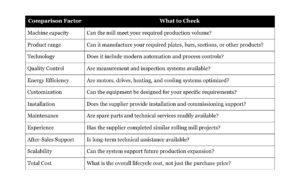 A supplier offering the lowest initial price may not always provide the lowest overall cost. Equipment reliability, energy consumption, maintenance, downtime, spare parts, and technical support can significantly influence the total cost of ownership.
What Should You Compare Before Buying a Rolling Mill Machine?
Before purchasing equipment, manufacturers should compare machines based on their actual production requirements.
Production Capacity
Determine how much steel the mill needs to process per hour, day, or year. The selected equipment should match current requirements while allowing room for future growth.
Product Specifications
Consider the type, size, thickness, width, and shape of the final product. A mill designed for heavy plates may not be suitable for producing long products such as bars or structural sections.
Automation Level
Compare manual, semi-automated, and highly automated systems. Higher automation may provide better process control and monitoring, but the investment should match the operational needs of the plant.
Energy Consumption
Energy efficiency is increasingly important in steel manufacturing. Compare the efficiency of motors, drives, heating systems, cooling systems, and other major energy-consuming components.
Maintenance Requirements
Check how frequently major components require maintenance and whether replacement parts are easily available. A reliable spare-parts supply can help reduce downtime.
Digital Capabilities
Modern systems may include real-time monitoring, automated quality control, predictive maintenance, and data analytics. These features can support more informed production decisions.
Total Cost of Ownership
Do not compare machines only by purchase price. Consider installation, energy use, maintenance, spare parts, downtime, upgrades, and expected service life.
How Do You Choose the Right Rolling Mill Machine?
The right rolling mill machine depends on the specific needs of the manufacturing operation. Before making a purchase, Evaluate:
- The type of steel products to be produced
- Required production capacity
- Raw material dimensions
- Final product specifications
- Hot or cold rolling requirements
- Required automation level
- Energy consumption
- Maintenance requirements
- Available installation space
- Future expansion plans
For example, a manufacturer producing heavy steel plates will have different equipment requirements from a company producing structural sections or wire rods. Selecting equipment based on the final product and expected production volume is therefore essential.
Should You Buy a New Rolling Mill or Upgrade an Existing One?
The answer depends on the condition and capabilities of the current production line.
If the existing equipment is structurally sound but lacks modern controls, manufacturers may be able to improve performance through targeted upgrades.
Potential modernization options include:
- New automation and control systems
- Advanced sensors
- Improved motors and drives
- Hydraulic roll-gap control
- Modern cooling systems
- Digital production monitoring
- Energy-efficient equipment
- Predictive maintenance systems
A modernization project can potentially extend equipment life while improving production performance and consistency.
However, if the existing equipment has reached the end of its useful life or cannot meet current production requirements, investing in a new rolling mill may be more practical.
How Does Digitalization Improve Rolling Mill Operations?
Digital technology is becoming an important part of modern rolling mill operations.
Real-Time Monitoring
Sensors can monitor temperature, pressure, speed, vibration, and other operating conditions. This allows operators to identify unusual conditions quickly.
Predictive Maintenance
Machine data can be analyzed to identify potential problems before equipment failure occurs. This can help maintenance teams plan repairs and reduce unexpected downtime.
Automated Quality Control
Automated inspection systems can monitor product dimensions and identify certain defects during production. Early detection can reduce the risk of producing large quantities of non-conforming material.
Data-Based Optimization
Historical and real-time data can help manufacturers understand how production parameters affect quality, productivity, and equipment performance. This information can support continuous process improvement.
What Are the Key Questions to Ask a Rolling Mill Machine Manufacturer?
Before selecting a supplier, ask:
- What production capacity can the machine achieve?
- What steel products can the mill produce?
- Can the equipment be customized?
- What automation and control systems are included?
- How is product quality monitored?
- What energy-efficiency features are available?
- What installation and commissioning services are provided?
- How quickly can spare parts be supplied?
- What maintenance support is available?
- Has the manufacturer completed similar projects?
- Can the system be expanded in the future?
- What is the estimated total cost of ownership?
These questions can help buyers compare suppliers more effectively and avoid making decisions based solely on initial equipment cost.
What Is the Future of Rolling Mill Technology?
The future of rolling mill technology is likely to focus on automation, digitalization, energy efficiency, predictive maintenance, and intelligent process control.
As steel manufacturers face increasing pressure to improve productivity and manage costs while reducing environmental impact, data-driven manufacturing will become increasingly important. The integration of sensors, automated controls, digital monitoring, and predictive analytics can help create more efficient and responsive production environments.
Final Thoughts
Choosing modern rolling mill machine technology is an important decision for any steel manufacturer planning a new facility, expanding production, or upgrading an existing plant. The right solution should be evaluated based on production capacity, product requirements, automation, energy efficiency, maintenance, technology, supplier experience, and long-term scalability.
Rather than comparing machines on price alone, manufacturers should consider the complete lifecycle of the equipment. Finding the right supplier, comparing technical specifications, evaluating total ownership costs, and planning for future production needs can help businesses make a more informed investment.
Modern rolling mill technology is moving toward increasingly connected and intelligent production. By selecting equipment that combines reliable mechanical performance with advanced automation and digital capabilities, steel manufacturers can build a stronger foundation for efficient, consistent, and future-ready production.
Frequently Asked Questions
What should I consider when comparing rolling mill machines?
Compare production capacity, product specifications, automation, energy efficiency, maintenance needs, machine reliability, and total cost of ownership. Also consider supplier experience and after-sales support.
How do I choose the right rolling mill for a steel plant?
Consider your product type, production volume, material size, required output, automation needs, and future expansion plans. Comparing suppliers such as RMT Tools, The Steefo Group, and Steewo Engineers can help you evaluate suitable rolling mill solutions.
What is the difference between a new rolling mill and modernization?
A new rolling mill is designed for a new production setup, while modernization upgrades existing equipment with improved automation, controls, sensors, drives, or digital monitoring systems. The right option depends on plant condition and production goals.
What are the main types of rolling mills?
Common types include two-high, three-high, four-high, cluster, and continuous rolling mills. The right type depends on the steel product, production capacity, and required dimensional accuracy.
What is the most important factor when choosing a rolling mill?
The most important factor is whether the machine can reliably meet your specific production requirements. Capacity, product specifications, automation, energy efficiency, maintenance, and future expansion should all be considered together.
Can an existing rolling mill be upgraded?
Yes. Existing mills can often be modernized through automation upgrades, new sensors, improved drives, hydraulic controls, digital monitoring, cooling improvements, and predictive maintenance systems.