




Quick Answer
A piecemeal rolling mill setup can cost less upfront because manufacturers can compare equipment prices and select individual suppliers. However, a turnkey rolling mill setup may offer better overall value by coordinating machinery, engineering, installation, and commissioning through one main supplier.
The cheaper option depends on production capacity, equipment specifications, installation requirements, and project management costs. To make the right decision, compare the total cost of getting the plant operational rather than looking at machinery prices alone.
Introduction
Setting up a rolling mill requires a significant investment in machinery, engineering, installation, and supporting infrastructure. Before purchasing equipment, manufacturers need to decide how to source and manage the project.
Two common approaches are turnkey and piecemeal rolling mill setups. A turnkey rolling mill project brings the agreed equipment and services together under one main contract, while a piecemeal approach involves purchasing machinery and services separately from different suppliers.
Both options can work well. Understanding their costs, benefits, and limitations helps steel manufacturers select a setup that meets production goals without unnecessary spending.
What Is a Turnkey Rolling Mill Setup?
A turnkey rolling mill setup is a project in which a main supplier or project contractor delivers an agreed combination of equipment and services. Depending on the contract, this may include engineering and design, machinery supply, installation, testing, and commissioning.
A typical project may involve:
- Reheating furnaces
- Rolling mill stands and gearboxes
- Shearing machines
- Pinch rolls
- Cooling beds
- TMT systems
- Material handling and automation equipment
The scope varies by supplier. Civil construction, electrical infrastructure, utilities, and certain installation services may be excluded, so buyers should review the complete project quotation.
Advantages of a Turnkey Setup
- Centralized project management: One main contractor coordinates the work covered by the agreement.
- Equipment compatibility: Machinery can be selected and engineered to operate as a connected production system.
- Simplified communication: Buyers have a main point of contact for project-related issues.
- Coordinated commissioning: Installation and testing can follow a common project schedule.
- Better cost visibility: A detailed quotation helps identify the expected investment and contractual exclusions.
Limitations of a Turnkey Setup
A turnkey solution may involve a higher initial quotation, depending on the supplier and scope of work. Buyers may also have less freedom to select individual equipment manufacturers, and changes made after the contract is signed can increase costs.
What Is a Piecemeal Rolling Mill Setup?
A piecemeal rolling mill setup involves purchasing individual machines and services from different suppliers. The plant owner manages the selection, procurement, and coordination of each part of the project.
For example, a manufacturer might buy a reheating furnace from one supplier, rolling mill stands from another, and shearing machines, gearboxes, and cooling beds from other manufacturers.
Advantages of a Piecemeal Setup
- Flexible supplier selection: Buyers can compare multiple quotations for individual machines.
- Potential purchase savings: Competitive pricing may reduce the initial equipment investment.
- Control over specifications: Each machine can be selected according to specific production needs.
- Phased investment: Equipment procurement can be staged where the plant design and project schedule allow it.
- Access to specialist suppliers: Manufacturers can select suppliers with experience in particular machinery or processes.
Limitations of a Piecemeal Setup
Purchasing equipment separately increases the responsibility of the plant owner or project team. They must ensure that machinery, drives, controls, dimensions, and material handling systems work together.
Other challenges include coordinating delivery schedules, managing multiple warranties, arranging installation, and resolving technical issues between suppliers. These additional responsibilities can reduce the savings achieved through lower equipment prices.
Turnkey vs Piecemeal Rolling Mill Setup: Key Differences
The main difference is how machinery, services, and project responsibilities are organized. A turnkey approach centralizes the agreed scope, while a piecemeal approach gives the buyer greater control over individual purchases.
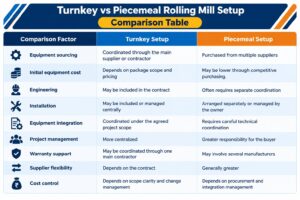
Neither approach is automatically cheaper. The result depends on the complete project scope, supplier capabilities, and the resources available to manage the installation.
Integration Risk vs Customization
Turnkey: A single supplier engineers the whole line, from the reheating furnace to the PLC and SCADA automation, so that the machines work together. This reduces the risk of capacity mismatches and bottlenecks between stages.
Piecemeal: This approach offers the most customization. Experienced steel producers can choose best-in-class equipment from different manufacturers. However, if rolling pressure, motor synchronization, or capacity levels are miscalculated, even slightly, the buyer usually absorbs the cost of fixing the system.
Project Timelines and Speed
Turnkey: With one supplier responsible, engineering, manufacturing, and foundation design can overlap. Contracts often include milestone-linked penalties, which gives the supplier an incentive to keep the project on schedule and reach commercial production sooner.
Piecemeal: The timeline is more vulnerable to delays. If the rolling mill stands arrive before the foundation anchor points are certified, or if an electrical contractor falls behind, the project can stall while storage and holding costs add up.
What Determines the Total Cost of a Rolling Mill Setup?
The total rolling mill setup cost includes more than the purchase price of machinery. Manufacturers should evaluate the following expenses before choosing a procurement model.
1. Machinery and Equipment Costs
Equipment costs depend on production capacity, product dimensions, required tolerances, automation, and the technical specifications of each machine.
Compare quotations using the same specifications. A lower-priced machine may not offer equivalent capacity, performance, or included components.
2. Engineering and Equipment Integration
The reheating furnace, rolling stands, gearboxes, shearing equipment, cooling bed, and material handling systems must work together across the entire rolling mill process.
When equipment comes from different suppliers, additional engineering may be required to coordinate dimensions, speeds, drives, controls, and production flow. Confirm whether integration and interface design are included in the quoted price.
3. Installation and Commissioning
Installation involves positioning machinery, completing mechanical and electrical connections, and preparing the equipment for operation. Commissioning may include testing, adjustments, and verification against agreed performance requirements.
Check whether these services are included in the turnkey contract or must be purchased separately. For a piecemeal setup, request separate quotations for each required service.
4. Transportation and Handling
Machinery may arrive in multiple shipments when purchased from different manufacturers. This can increase freight coordination, unloading, storage, and handling requirements.
Compare delivery terms and the total cost of transporting equipment to the plant rather than comparing equipment prices alone.
5. Project Delays
Delays can occur when equipment arrives late, installation teams are unavailable, or components require modification. For a rolling mill, delayed commissioning can postpone the start of commercial production.
A coordinated project schedule can help reduce these risks, but it does not eliminate them. Buyers should review delivery commitments, dependencies, and responsibility for delays in the contract.
6. Maintenance and Spare Parts
Long-term costs include routine maintenance, replacement parts, technical support, and energy consumption. Different equipment suppliers may have different warranty conditions, spare part lead times, and after-sales services. Use a rolling mill maintenance checklist to estimate recurring costs.
Compare the expected operating and maintenance costs alongside the initial investment. A machine with a lower purchase price may not be the most economical choice over its service life.
Turnkey vs Piecemeal Rolling Mill Cost Comparison (India Example)
The cost of setting up a rolling mill depends on production capacity, machinery specifications, installation requirements, and project scope. A turnkey setup may offer a coordinated solution, while a piecemeal setup allows manufacturers to purchase equipment from different suppliers.
The following table provides an illustrative cost comparison for a hypothetical rolling mill project in India. These figures are approximate examples for comparison purposes, not verified market quotations.
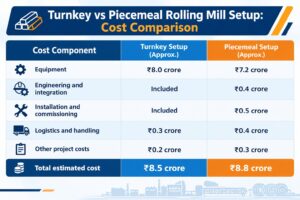
Engineering, integration, installation, and commissioning are assumed to be included in the turnkey equipment package for this example. Actual contract terms may differ.
Which Setup Costs Less?
In this example, the turnkey setup costs approximately ₹8.5 crore, while the piecemeal setup costs approximately ₹8.8 crore. This makes the turnkey option around ₹30 lakh less expensive overall, even though the piecemeal option has a lower initial equipment price.
However, actual costs can vary depending on plant capacity, equipment quality, supplier pricing, civil construction, electrical infrastructure, taxes, and commissioning requirements. Manufacturers should obtain comparable supplier quotations before making an investment decision.
Key takeaway: Compare the complete project cost rather than the machinery price alone to determine which rolling mill setup offers better value.
When Should You Choose a Turnkey Rolling Mill Setup?
A turnkey setup may be suitable for manufacturers who want centralized project coordination and a clearly defined scope of responsibility.
Consider this approach if you:
- Are setting up a new plant from the ground up.
- Need several machines integrated into one production line.
- Have limited in-house engineering or project management resources.
- Prefer a coordinated installation and commissioning schedule.
- Want one main contractor to manage the agreed project scope.
Before signing the contract, confirm the machinery list, production requirements, delivery schedule, performance guarantees, warranty terms, and excluded services.
When Should You Choose a Piecemeal Rolling Mill Setup?
A piecemeal setup may suit manufacturers who have experienced technical teams and want greater control over procurement.
Consider this approach if you:
- Are revamping or upgrading an existing rolling mill.
- Need to replace only selected machines.
- Have the expertise to compare technical specifications.
- Can coordinate several suppliers and installation teams.
- Want to purchase specialist machinery from different manufacturers.
- Plan to invest in equipment in phases.
For this approach, prepare a detailed machinery specification sheet and define the technical interfaces between suppliers before placing orders. This can help avoid compatibility issues and unexpected installation expenses.
How to Reduce Rolling Mill Setup Costs
Manufacturers can control project costs by making informed procurement decisions before purchasing machinery.
- Define production requirements: Establish the required output, product sizes, material grades, and operating schedule.
- Prepare a complete machinery list: Identify all equipment and supporting systems needed for the planned production process.
- Compare equivalent quotations: Ensure that suppliers quote against the same technical specifications and project scope.
- Check integration requirements: Confirm that machine capacities, drives, controls, and material handling arrangements are compatible.
- Calculate total project costs: Include engineering, freight, installation, commissioning, infrastructure, and contingency allowances.
- Evaluate long-term expenses: Compare energy use, maintenance, spare parts, warranties, and service availability.
- Plan for future expansion: Consider realistic production growth before finalizing the plant layout and equipment capacity.
A detailed project checklist can help buyers identify missing costs before procurement begins. It also makes supplier quotations easier to compare fairly.
Conclusion
The choice between a turnkey and piecemeal rolling mill setup depends on your budget, technical capabilities, production requirements, and project timeline. A turnkey solution can simplify coordination and equipment integration, while a piecemeal approach offers greater supplier flexibility and the potential for lower purchase prices.
For an accurate comparison, evaluate the complete cost of making the rolling mill operational, including engineering, installation, commissioning, and long-term maintenance.
Planning a rolling mill project? Contact RMT Tools to discuss your machinery requirements and find a suitable solution for your steel production needs.
Frequently Asked Questions
Is a turnkey rolling mill setup cheaper than a piecemeal setup?
Not always. A piecemeal setup may reduce initial equipment costs, while a turnkey project may reduce coordination and integration expenses. The more economical choice depends on the complete project cost and the buyer’s ability to manage suppliers.
What is included in a turnkey rolling mill project?
Depending on the contract, a turnkey project may include engineering, machinery supply, installation, automation, testing, and commissioning. Civil construction, utilities, transportation, and other services may be excluded, so buyers should confirm the exact scope.
Can I save money by buying rolling mill machinery separately?
Yes, purchasing machinery separately can help you negotiate competitive prices and select specialist suppliers. However, the savings should be compared against additional engineering, installation, freight, integration, and project management costs.
Which setup is better for a new rolling mill plant?
A turnkey setup may be more convenient for a new plant that requires several machines to operate as one coordinated production line. A piecemeal setup can also work when the owner has the technical expertise and resources to manage procurement and integration.
What hidden costs should I check before setting up a rolling mill?
Check engineering, civil work, electrical systems, freight, unloading, installation, commissioning, equipment modifications, spare parts, and delays. Also confirm taxes, warranty exclusions, and any services not covered by the supplier’s quotation.
How can I compare rolling mill equipment suppliers?
Compare technical specifications, production capacity, equipment quality, delivery schedules, installation requirements, warranty conditions, spare parts, service support, and total project costs. Ask suppliers to identify all exclusions and confirm their responsibilities in writing. For a step-by-step approach, read our guide on how to choose the right hot steel rolling mill manufacturer.