




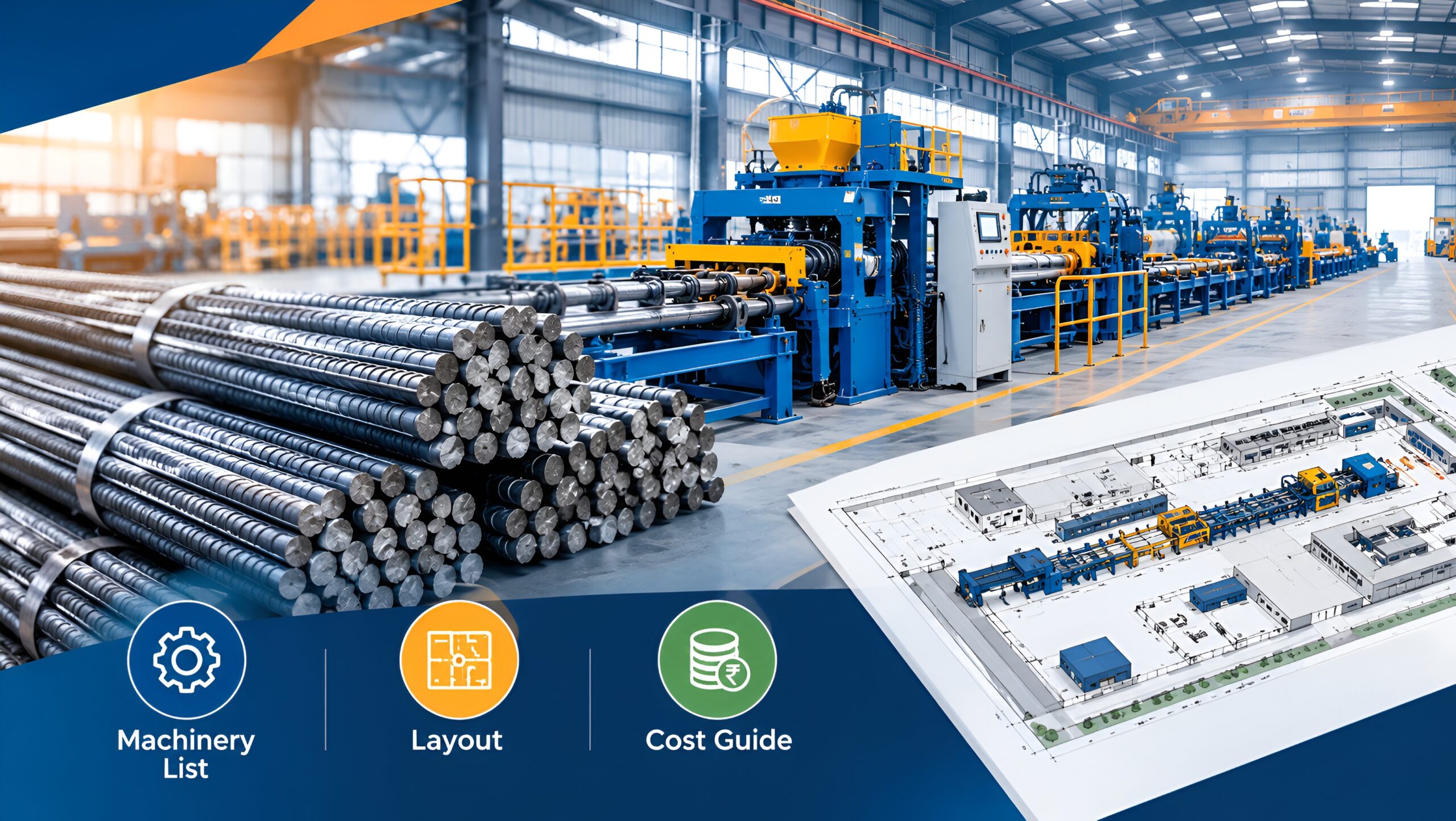
Setting up a TMT bar plant requires the right combination of machinery, production capacity, material handling systems, and plant layout. Each machine plays a specific role in converting steel billets into finished TMT bars. Choosing equipment based on your required output, bar sizes, available space, and budget can help improve production efficiency and reduce operating challenges.
This buyer’s guide explains the machinery needed for a TMT bar manufacturing plant, the typical rolling line sequence, important layout considerations, approximate setup cost, the legal permissions required, and factors to evaluate before purchasing equipment.
Quick Answer: What Machinery Is Needed to Set Up a TMT Bar Plant?
A typical TMT bar plant requires a billet reheating furnace, roughing stands, intermediate stands, finishing stands, shearing equipment, a TMT quenching system, a cooling bed, a cut-to-length system, and finishing equipment for bundling and handling bars.
The complete setup may also require gearboxes, motors, electrical and automation systems, roller tables, water circulation equipment, and material handling cranes. The final TMT plant machinery list depends on production capacity, billet dimensions, finished bar sizes, and the level of automation.
TMT Plant Setup Cost: Approximate Investment Range
The cost of setting up a TMT bar plant depends on production capacity, billet size, level of automation, furnace type, and whether you choose a new or revamped line. The ranges below are indicative figures for budgeting only. For an accurate number, request a quotation based on your production requirements.
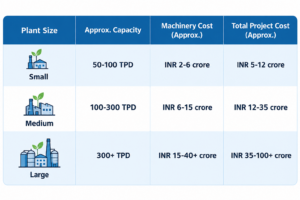
These are planning estimates, not a quotation. Actual cost varies with scope of supply, automation, site conditions, and market prices.
What Is Included in the Total Project Cost?
- Rolling mill machinery: reheating furnace, rolling mill stands, shears, cooling bed, gearboxes, motors, and drives.
- Civil work: land, building, foundations, and the rolling mill shed.
- Utilities: power connection, transformers, water circulation, and treatment.
- Material handling: cranes, roller tables, and storage areas.
- Installation and commissioning: erection, trial runs, and operator training through installation services.
- Working capital: billet stock, fuel, manpower, and initial running costs.
- Approvals: statutory permissions and product certification required in your region.
Factors That Change the Cost of a TMT Plant
- Production capacity: higher output needs a larger furnace, more stands, and stronger drives.
- Bar size range: a wider diameter range increases roll and changeover requirements.
- Automation level: manual, semi-automatic, and fully automatic lines differ widely in price.
- Billet size and grade: these affect furnace and mill stand design.
- Furnace fuel type: fuel availability and efficiency influence both purchase and running cost.
- New vs revamped plant: revamping an old plant can cost less than a completely new setup.
- Location: power tariff, water supply, labour, and logistics change the total investment.
Looking for a full project plan instead of individual machines? See our turnkey projects to understand how a complete plant is planned and delivered.
Legal Permissions and Licenses Needed to Set Up a TMT Bar Plant in India
Yes, legal permissions are required to set up a TMT bar plant. Before construction and before production, you need business registrations, environmental consents, safety approvals, and product certification. Typical approvals include a factory license, GST registration, pollution control board consent, fire NOC, and BIS certification for the finished bars.
Approvals Needed Before Construction
| Approval | Issued By | Why It Is Needed |
|---|---|---|
| Business registration, PAN and GST | Registrar / Income Tax / GST department | Legal identity and tax compliance for the business |
| Udyam (MSME) registration | Udyam portal | Helps with loans, subsidies, and scheme benefits |
| Industrial land and land use permission | Local authority or industrial area authority | The land must be approved for industrial use |
| Building plan approval | Local body or industrial area authority | Needed for the rolling mill shed and plant buildings |
| Consent to Establish (CTE) | State Pollution Control Board | Required before construction and installation of machinery |
| Fire NOC | State fire department | Safety approval for furnace areas and plant buildings |
| Power load sanction | State electricity board | A rolling mill needs a high electrical load |
| Groundwater NOC | State or central groundwater authority | Needed if you plan to draw water from a borewell |
Approvals Needed Before Production
| Approval | Issued By | Why It Is Needed |
|---|---|---|
| Consent to Operate (CTO) | State Pollution Control Board | Required before commercial production begins |
| Factory license | State Factories department | Required to run a manufacturing unit under the Factories Act |
| BIS certification (IS 1786) | Bureau of Indian Standards | IS 1786 is the Indian standard for TMT bars, and BIS certification is needed to sell grades such as Fe500D and Fe550 |
| EPF and ESIC registration | EPFO / ESIC | Compliance for employees and workers |
| Fuel storage license | PESO | Needed only if you store furnace oil, LPG, or gas above the limit |
| Weighbridge verification | Legal Metrology department | Required for weighing scales used in trade |
Important Points to Remember
- Start early: CTE, power sanction, and BIS certification can take the longest, so begin these before ordering machinery.
- Environmental clearance: Whether a separate environmental clearance is needed depends on plant size, furnace type, and any steel-making unit attached to the plant. Confirm this with your State Pollution Control Board.
- Rules vary by state: Fees, forms, and categories differ between states. Check your state’s industries department or single-window portal.
- Check the latest BIS requirements: Quality control rules can change, so verify the current requirement on the BIS website before applying.
This section is general information, not legal advice. Consult a qualified industrial consultant, chartered accountant, or lawyer before applying.
RMT Tools supports buyers through the complete project journey. Learn more about our services for setting up new plants to plan machinery, layout, and timelines together with your approvals.
1. TMT Plant Machinery List: Equipment and Its Functions
A TMT rolling mill uses a sequence of machines to transform heated steel billets into finished reinforcement bars. The following table outlines the main equipment and its purpose.
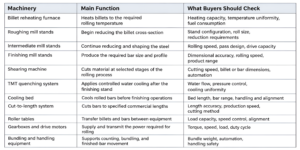
Not every plant uses identical equipment. For example, the type of shear, cooling bed, and finishing arrangement can differ according to the production line design.
2. How a TMT Bar Manufacturing Plant Works
Understanding the production sequence helps buyers identify which machines must work together and where each unit should be positioned.
Step 1: Billet Reheating Furnace
Steel billets are heated to a suitable rolling temperature before entering the mill. Consistent heating helps the steel pass through the rolling stands more smoothly.
When selecting a furnace, evaluate the billet size, required hourly output, heating method, fuel availability, and temperature control system. You can read more about reheating furnace working principles and design.
Step 2: Roughing Mill Stands
The heated billet enters the roughing section, where the first major reductions in cross-section take place. The arrangement of the stands depends on the billet dimensions and the planned rolling schedule.
Buyers should check the stand design, roll diameter, reduction per pass, and drive requirements.
Step 3: Intermediate Mill Stands
The intermediate section continues reducing the steel and prepares it for the finishing stage. Proper coordination between stand speeds and pass design helps maintain stable rolling conditions.
The number and configuration of stands should be selected according to the required output and range of finished bar sizes. The choice between layouts is also explained in our guide to tandem and cluster steel rolling mills.
Step 4: Finishing Mill Stands
Finishing stands produce the final bar dimensions and ribbed profile required for the intended product specification. Rolling speed, roll pass design, and dimensional control are important considerations at this stage.
The finishing section must also be compatible with the downstream TMT quenching system.
Step 5: Shearing Equipment
Shears are used at different points in a rolling line for tasks such as cropping, dividing, or cutting the moving bar, depending on the mill design. Common options include the flying shear for cutting moving bars.
The required shear type and capacity should match the line speed, material dimensions, and cutting duty. Buyers should confirm the function of each shear rather than selecting equipment by name alone. See these 5 tips to consider before buying a shearing machine.
Step 6: TMT Quenching System
After the finishing stand, the hot bar passes through a controlled water-cooling system. This rapid surface cooling is followed by further temperature equalization and self-tempering as the bar moves along the line.
The quenching system must be designed around the rolling speed, bar diameter, water supply, and required product properties. Process design and testing are essential to achieve consistent results.
Step 7: Cooling Bed
The cooling bed receives the rolled bars and allows them to cool before final cutting and handling. Its dimensions and transfer mechanism affect the line’s ability to handle different bar sizes and production rates.
A suitable cooling bed should provide enough space and reliable bar movement without creating a bottleneck.
Step 8: Cut-to-Length and Finishing Section
Once the bars reach the required stage of cooling, they are cut to specified commercial lengths. The finishing section may also include counting, bundling, tying, weighing, and dispatch handling.
The cut-to-length arrangement should support the product lengths and bundle specifications required by your customers.
3. TMT Rolling Mill Layout: How to Arrange the Equipment
A well-planned TMT rolling mill layout provides a clear production flow from billet entry to finished-bar dispatch. Equipment placement should minimize unnecessary material movement, provide safe operator access, and allow room for maintenance.
A typical linear arrangement is:
- Billet storage and charging area
- Reheating furnace
- Roughing mill section
- Intermediate mill section
- Finishing mill section
- TMT quenching system
- Cooling bed
- Cut-to-length and finishing section
- Bundling, storage, and dispatch area
Supporting systems such as electrical panels, drive motors, gearboxes, water treatment and circulation equipment, and maintenance access areas must also be included in the overall plan.
Sample TMT Plant Layout: Conceptual Flow
Billet Storage → Reheating Furnace → Roughing Stands → Intermediate Stands → Finishing Stands → TMT Quenching System → Cooling Bed → Cut-to-Length → Bundling and Dispatch
This is a simplified process-flow concept, not an engineering drawing. The actual arrangement may use different orientations, transfer tables, shears, or auxiliary equipment depending on the selected machinery and site conditions.
Important Layout Considerations
- Available land and building dimensions: Confirm the usable length, width, height, foundations, and access routes.
- Production flow: Keep billet movement and finished-bar handling as direct as practical.
- Equipment foundations: Account for the loads, vibration, alignment, and installation requirements of rolling stands and drive systems.
- Utilities: Plan the electrical supply, cooling water, fuel, drainage, and compressed air where required.
- Maintenance access: Provide adequate clearance around motors, gearboxes, stands, and other serviceable equipment.
- Worker safety: Include guarded moving parts, emergency access, safe operating zones, and suitable handling arrangements.
- Future expansion: Consider whether additional stands or supporting equipment may be needed later.
A detailed layout should be developed with the machinery supplier and qualified plant engineers after reviewing the site dimensions and production requirements. RMT Tools offers designing services to support this stage.
4. TMT Plant Capacity: How to Choose the Right Production Output
TMT plant capacity should be selected according to expected demand, available raw materials, working hours, product specifications, and the capabilities of the complete production line.
A plant’s rated or theoretical output is not necessarily the amount of finished product it will sell or dispatch. Actual production depends on operating hours, downtime, rolling speed, product mix, changeovers, material yield, and equipment availability. Learn more about the factors affecting the performance of steel rolling machines.
Factors That Affect TMT Plant Capacity
1. Required daily or annual production
Estimate the quantity of finished bars you expect to produce and sell. Avoid selecting a line based only on maximum advertised output.
2. Finished bar diameter range
The required product range affects roll pass design, rolling speed, changeover time, and equipment configuration.
3. Billet dimensions and supply
Billet size, quality, availability, and delivery consistency influence furnace loading and rolling performance.
4. Rolling line speed
The furnace, mill stands, shears, quenching system, and downstream handling equipment must operate as a coordinated line.
5. Operating schedule
Planned production hours should account for maintenance, stoppages, product changes, and other operational interruptions.
6. Material yield
Billet input and saleable finished-bar output can differ because of process losses, crop ends, scale, and rejected material.
Example: Estimating Daily Production
Suppose a plant has a planning target of 30 tonnes per hour and is scheduled to operate for 16 hours per day.
The theoretical daily output would be:
30 tonnes/hour × 16 hours = 480 tonnes per day
This is a planning example, not a guaranteed production figure. Actual output will be lower if the line experiences downtime, speed restrictions, product changeovers, or material losses. Use verified supplier performance data and realistic operating assumptions when evaluating a plant.
5. How to Select TMT Plant Machinery for Your Requirements
Before requesting quotations, prepare a clear equipment specification. This helps suppliers recommend compatible machinery instead of quoting individual machines that may not work efficiently as a complete line.
Create a Machinery Requirement Checklist
- Required finished-bar diameter range
- Target production in tonnes per hour, day, or year
- Billet dimensions and grade
- Required commercial bar lengths
- Reheating furnace capacity and fuel type
- Number and configuration of rolling stands
- Required shears and their functions
- TMT quenching system specifications
- Cooling bed dimensions and transfer arrangement
- Gearboxes, motors, drives, and automation
- Water circulation and treatment requirements
- Electrical load and utility requirements
- Installation, commissioning, and operator training
- Spare parts, maintenance support, and warranty terms
Why Complete-Line Compatibility Matters
A high-speed finishing mill will not deliver its full potential if the furnace cannot provide billets at the required rate or if the cooling bed cannot handle the finished bars. Likewise, undersized shears or poorly coordinated drive systems can restrict the entire line.
Evaluate the machinery as one integrated production system. Ask suppliers to explain their capacity assumptions, expected operating conditions, scope of supply, and the performance tests available before final acceptance. This guide on how to choose the right manufacturer for a hot steel rolling mill plant can help you compare suppliers.
6. Common Mistakes to Avoid When Setting Up a TMT Bar Plant
- Choosing equipment only by price: Compare specifications, expected output, energy use, maintenance needs, and support in addition to the purchase price.
- Ignoring downstream capacity: Cooling beds, shears, and finishing equipment must be able to handle the output of the rolling section.
- Underestimating utility requirements: Check the power supply, water availability, furnace fuel, and supporting infrastructure before finalizing equipment.
- Using an unverified layout: Confirm foundations, clearances, transfer paths, and maintenance access with qualified engineers.
- Assuming rated capacity equals saleable output: Ask for realistic production estimates based on the intended bar sizes, operating schedule, and expected downtime.
- Overlooking future service needs: Check spare-part availability, technical support, and the supplier’s installation and commissioning scope. A regular rolling mill maintenance checklist also helps avoid unplanned downtime.
- Leaving out the cost of utilities and working capital: The total project budget should include more than machinery, as explained in the cost section above.
7. Explore Rolling Mill Machinery from RMT Tools
Selecting the right rolling mill equipment starts with understanding your production targets and the technical requirements of the complete line.
RMT Tools manufactures rolling mill machinery and related equipment for steel processing applications. Buyers planning a TMT bar plant can review our TMT plant solutions, explore setting up new plants, and view our certifications, then discuss the machinery configuration needed for their intended production process.
Before finalizing a purchase, share your target capacity, billet dimensions, finished-bar sizes, available site space, and project requirements with the supplier.
Planning a TMT bar plant? Contact RMT Tools to discuss your rolling mill machinery requirements, equipment configuration, and project cost.
Frequently Asked Questions
1. What machinery is needed to set up a TMT bar plant?
A typical setup includes a billet reheating furnace, roughing, intermediate and finishing mill stands, shearing equipment, a TMT quenching system, cooling bed, cut-to-length equipment, roller tables, drive systems, and material handling equipment. The final list depends on the production capacity and plant configuration.
2. What is the correct sequence of machinery in a TMT rolling mill?
A typical sequence is billet charging, reheating furnace, roughing stands, intermediate stands, finishing stands, TMT quenching, cooling bed, cut-to-length operations, and bundling. Shears and transfer equipment are positioned according to the specific mill design.
3. How do I choose the capacity of a TMT bar plant?
Start with expected market demand, required daily output, product diameter range, billet availability, and planned operating hours. Then verify that the furnace, rolling stands, quenching system, cooling bed, and finishing section can support the target output as one integrated line.
4. What should a TMT rolling mill layout include?
The layout should cover billet storage, the reheating furnace, rolling stands, quenching equipment, cooling bed, cutting and bundling areas, utilities, electrical systems, maintenance access, and finished-product storage. Site dimensions and engineering requirements determine the final arrangement.
5. Can a TMT plant produce different bar diameters?
A suitably designed plant can produce a specified range of bar diameters. The achievable range depends on the mill configuration, roll pass design, equipment capabilities, and changeover requirements. Confirm the exact product range with the machinery supplier.
6. Why is the cooling bed important in a TMT plant?
The cooling bed provides space for rolled bars to cool and move through the finishing process. Its capacity and handling arrangement must match the rolling line’s output to prevent congestion and production delays.
7. What information should I provide when requesting a TMT plant machinery quotation?
Provide your target output, billet dimensions, finished-bar diameter range, commercial lengths, available site dimensions, utility details, automation expectations, and project timeline. This allows suppliers to assess the required equipment and prepare a more relevant quotation.
8. Does a TMT bar plant require a custom layout?
The layout should be developed around the selected machinery, site dimensions, production capacity, utility connections, and material flow. A conceptual layout is useful for planning, but final equipment placement and foundations require detailed engineering.
9. How can I avoid bottlenecks in a TMT rolling mill?
Match the capacity and operating speed of the furnace, rolling stands, shears, quenching system, cooling bed, and finishing equipment. Review the complete production flow with the supplier and verify performance assumptions before purchasing the machinery.
10. Is a license required to set up a TMT bar plant in India?
Yes. A TMT bar plant typically needs business and GST registration, Consent to Establish and Consent to Operate from the State Pollution Control Board, a factory license, fire NOC, power sanction, and BIS certification (IS 1786) for the finished bars. Requirements vary by state, so confirm the exact list with your local authorities.
11. How much does it cost to set up a TMT bar plant?
The cost depends on plant capacity, automation level, billet size, furnace type, and site conditions. A small plant needs a much lower investment than a large continuous line, and the total project cost also includes civil work, utilities, installation, and working capital. Share your target capacity with RMT Tools to get a quotation for your project.